
Welcome to another month down: August edition. I sat down at the start of the month intending to work on documentation and build the 1.0 game, and somewhere along the way, some dependencies were finally unblocked and I was able to add a long-requested export option. Shall we begin?
You’ve asked for it for years — and now I can finally deliver: RPG Architect games now port to the browser. The engine has been ported to run under web assembly (wasm) thanks to KNI finally updating to .NET 10. I’ve tested various projects (the 1.0 game, which is a very hefty 3D project, the 2D JRPG sample, the templates, and the ARPG sample) — and they all work. Performance is another question. Originally, I was getting around .3 FPS and I managed to get it up to a much better 100 FPS on the 2D JRPG project. Some things are still slow to load, there are still bumps, but I’ve made tremendous progress. You’ll need to deploy it to a web server, though — wasm doesn’t just play in the browser on its own — it needs to be served. But uploading it all to itch.io or any other provider should be just fine.
I want to set expectations — just because the sample runs on my machine, it doesn’t mean that you’re going to be rendering Crysis in the browser. The browser is a genuinely hostile platform compared to desktop — there’s no real threading, your download is your load time, and a whole pile of things that the desktop engine was happy to run, turned into hard failures for the web. I found an empty code branch that had been sitting there harmlessly for years and only announced itself by rendering exactly zero fonts. I spent most of the final week on load performance and I’m not finished. But it works, it’s in the build already, and I would very much like for you to go and break it.
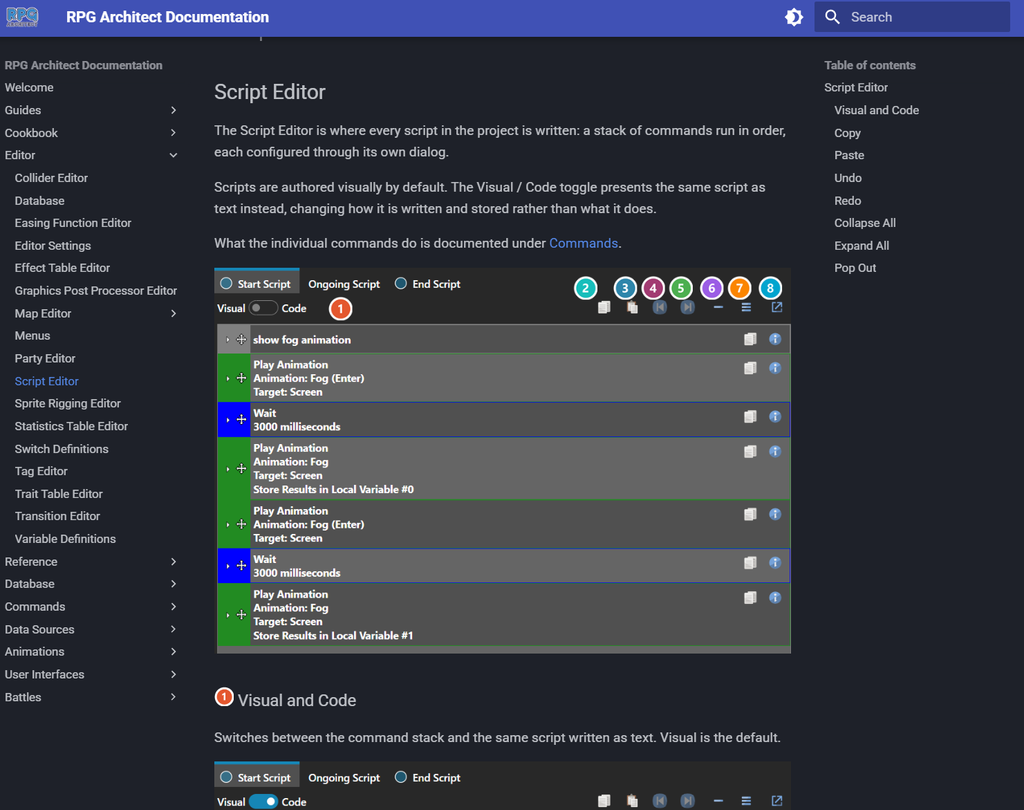
Documentation ate the other half of the month, and I think it was worth every hour. The real story is “how” it is built — I’ve meticulously built scripts that go and mine screenshots, connecting that to shortcuts/input, and then throw in the actual text to tell you what it does. So, the editor actually has entries — and annotations to help you know what is what. It’s not perfect — it’s not going to tell you how to build your game, but it should hopefully help you understand how everything works. And if the editor’s interface changes? Great — I just mine it again. It’s a one-and-done thing, minus needing to update shortcuts and verbal descriptions.
Minimaps came a long way from last month’s very-outdated preview video. Beyond the basics you now get clipping and masking (so a circular or custom-shaped minimap actually clips properly instead of drawing a rectangle and hoping), rotation that tracks the camera, and per-object markers with overrides — all of which I’ve had my hands on and am happy with. There’s also a full set of script commands now — open, close, toggle, set level, set zoom, and pan — and I’ll be honest that those are not tested completely.
Something I’ve been neglecting a while — camera transitions with movement. There’s now a Camera Follow Easing option in Map Configuration, so the camera can trail the player instead of being stuck to them. This was a fun one to build, since I had a few mistakes (that you never saw), which involved the camera yo-yo’ing. Theoretically, you could still probably do this with the bounce easing function, if you want to pretend you were part of that historic moment for me.
Graphics Post Processing… we’re done right? No. After it came to my attention that someone was building the old console hardware palettes as a shader… I had to go add them in. We have 11 new effects that simulate third generation consoles and prior (and theoretically the Virtual Boy). They’re named descriptively rather than by console.
Numerous bugs got crunched. I think around 50. A few related to vehicles, a few related to fences. Tile tags can now apply to fences as well — so you can make some “fences” that are capable of being passed. I also noticed that Gamepad controls weren’t in… mostly when I got to ARM64… But I’ll talk about that later — they’re in now. Preload performance was also improved, thanks to the issues noticed on web. You may see slightly longer load times (and most of this is probably a 1-2% improvement at best in the desktop engine), but the web engine (as of 8/28) runs anywhere from 5-40% better.
I took a slight detour on a sidequest, since one of our moderators keeps flashing ARM64 Linux hardware, but could never get it to work. I bought a cheap ARM64 Linux handheld and spent a couple of days getting the engine to build and run on it natively. It renders, it takes input, it goes fullscreen, and it publishes. It doesn’t run great on the limited hardare, but it does run. Probably worse than web in most cases. Then again, the hardware I tested on was a quad-core, 1GB (no video) RAM device.
…but it runs!
How about 1.0? Progress continues on the dungeon crawler variant of the game. I have a ton of new monsters, battle programming, animations, items, and equipment added. I’ve even managed to get the basic “flow” working. I’ve squashed a few bugs and still have some game design choices to make in regard to the visibility of the ramps that go down.
In terms of actual 1.0 — we’re inching ever so closer. But the point is that it is inching — not running. Q4 of 2026 would likely be a miracle and Q1 of 2027 looks more realistic. I have a lot of the components built, but as can be expected, if the workflow sucks, I’m going to improve it.
In September, I’m planning on continuing efforts on the 1.0 game. With any luck, I might start throwing in some dialogue and making the gameplay loop a bit more defined.
That’s it for August. A lot more than I had anticipated in doing on the feature/bug side, but it is what it is — it’ll lead to a better product in the long run. And all that said, it’s not like we’re not “technically” at a 1.0 stage anyway — this is just about adding as much polish as possible to “consider” it 1.0. And then I’ll get to start adding the much-requested tactical battle system and a ton more.
As always:
Thank you so much for your support so far. I’m looking forward to building this community further and giving you the engine you may not have known you always wanted!